
How to Use HubSpot AI to Build a Better Sales Playbook
You don't have to start a sales Playbook...

September 25, 2026
Founders assume they know their close rate. That word, assume, is doing all the work in that sentence. The real number is usually sitting in a stage report inside the CRM already, untouched, because nobody’s pulled it apart in months.
That’s not a data problem. It’s an attention problem. And it’s an easy one to fix once you know where to look.
A real conversion rate is closed won deals divided by total deals that entered the pipeline. That’s it. Not an industry benchmark you read somewhere. Not what it felt like this quarter. A specific number you can point to inside your own CRM, calculated from your own deals.
A lot of founders don’t have that number memorized, and there’s nothing wrong with that on its own. The problem starts when a gut-feel number gets treated as if it were the real one. “We close about a third of what we quote” is a guess dressed up as a fact. It might be true. It might be off by double. Nobody’s actually counted, so nobody knows which.
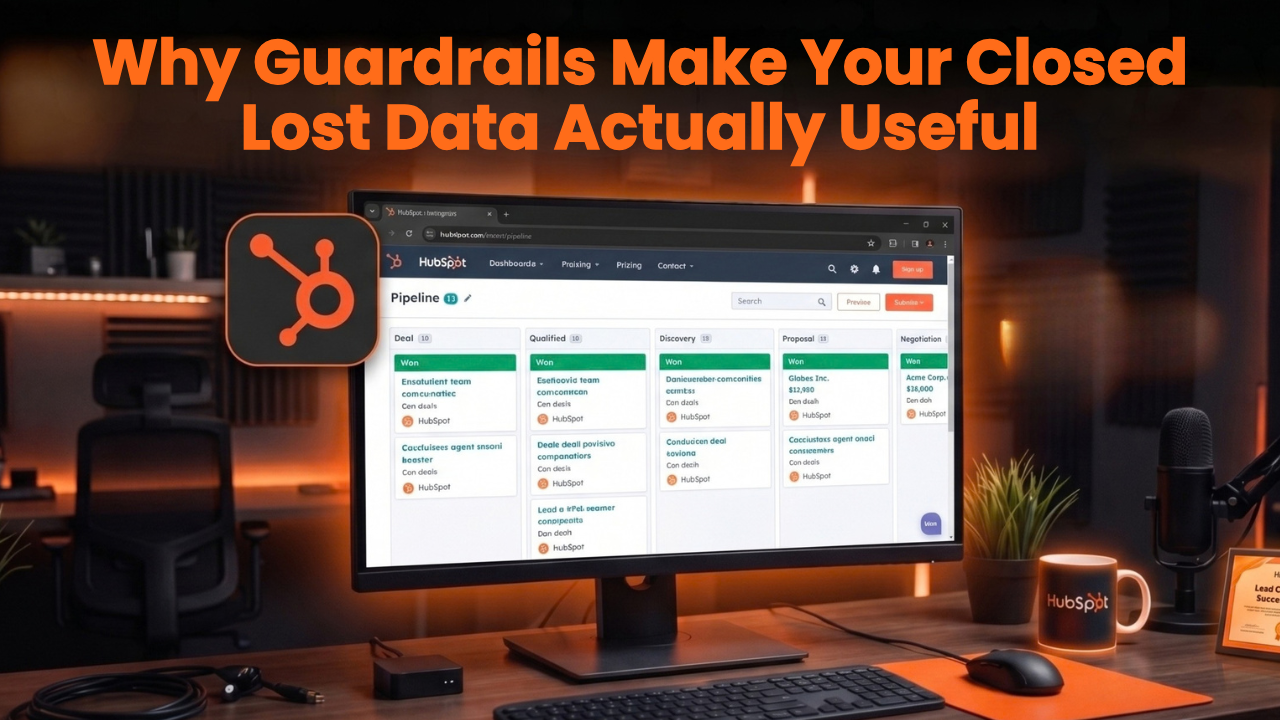
Here’s an example from a HubSpot portal we reviewed. Thirty seven deals moved through a single sales pipeline. Two closed won. Seventeen closed lost. Run the math and that’s a 5% win rate against the full pipeline, not the number anyone in that business would have guessed without sitting down and counting.
That alone is worth knowing. But there’s a second layer to it. Every one of those 17 lost deals had a blank Closed Lost Reason field. The team had a real number now, a win rate they could actually defend, but no record of why 17 deals didn’t close. Was it price? Timing? A competitor? Nobody could say, because nobody had written it down.
A stage report will tell you what happened to a deal. It won’t tell you why, unless someone’s actually filling in the reason at the moment a deal dies. HubSpot doesn’t force that by default. It just lets the field sit empty.
Not knowing your real number is expensive in an obvious way. If you think you’re closing a third of your pipeline and you’re actually closing one in twenty, every forecast built on that assumption is wrong before you’ve typed it into a spreadsheet. Reps get quota targets built on a fiction. Founders make hiring and spending decisions on a number that was never real.
Knowing the number but not the reason is a quieter kind of expensive. You can watch the same 17 deals die for the same unaddressed reason every quarter and never notice the pattern, because the pattern was never written down anywhere. A leak you can’t diagnose is a leak you can’t fix. It just keeps draining the same amount, quarter after quarter, and everyone treats it as normal because it’s always been that way. We wrote about this same kind of slow, invisible drag in Why Execution Capacity Is What’s Killing Your Pipeline, and a blank reason field is exactly the kind of small, unglamorous gap that story is about.
The fix here isn’t a new dashboard. Founders love a new dashboard, and a new dashboard changes nothing if the underlying habit doesn’t change with it. The fix is a guardrail, something that makes the right behavior automatic instead of hoping a rep remembers to do it during a busy week.
In practice, that means setting Closed Lost Reason as a required property on the Closed Lost stage itself. A deal can’t move into that stage anymore with the field left blank. The system stops the gap at the exact moment it would otherwise happen, instead of asking someone to catch it later in a review nobody has time for.
That’s the same approach we take across the board. As we covered in What Is Revenue Operations? (And Why It’s Not Just Sales Ops), RevOps work isn’t a report you hand over once. We place a screened, trained Operator inside your HubSpot who builds guardrails like this one and checks that they actually hold, co-managed by a Lead Operator on our side. You direct the daily priorities. We stay accountable for the execution, including the unglamorous parts, like a form field nobody thought to make mandatory until it mattered.
If you’ve never sat down and calculated your actual win rate against your full pipeline, that’s worth twenty minutes before you build anything else. And if you already know the number but not the reasons behind it, that gap is fixable in an afternoon, not a quarter.
You don't have to start a sales Playbook...
A lot of founders have never actually calculated...
HubSpot already scores every contact in your portal...

Your CRM knows a deal has been sitting...
Your reps are still logging call data by...