The Bow Tie Funnel Is the Framework Your Revenue Operations Are Missing
The traditional funnel stops at the close. The...
September 14, 2026
Every B2B company has a funnel. And almost every one of them is using the wrong half of it.
The traditional funnel does a decent job of showing how leads move from awareness to closed-won. But it stops there. It treats the close like the finish line. For B2B companies, the close is actually the starting line.
That is where the bow tie funnel comes in.
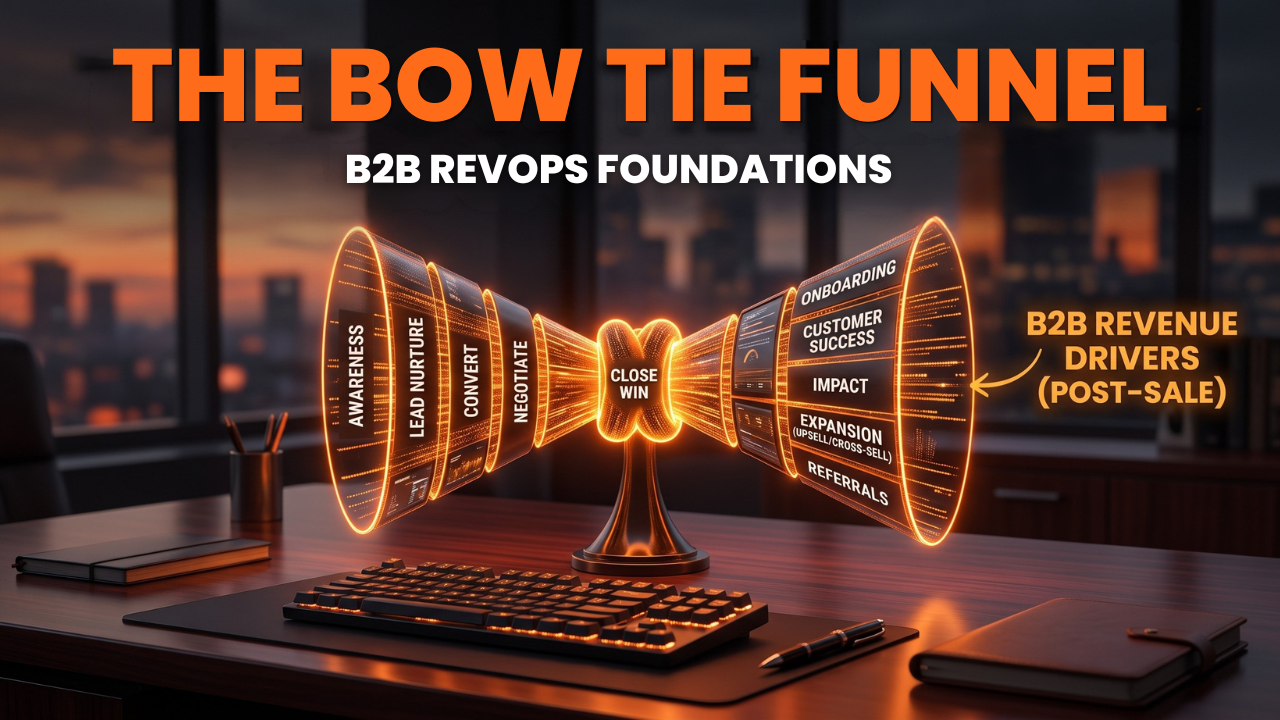
The bow tie funnel takes the traditional funnel and mirrors it. On the left side, you have everything you already know: awareness, nurture, conversion, negotiation, close. On the right side, you have everything that actually drives revenue for B2B companies: onboarding, delivery, relationship building, and expansion.
The shape looks like a bow tie because the close sits in the middle, and the funnel opens back up on the other side as you grow revenue from the clients you already have.
This is the framework we use to build revenue operations for B2B companies. It gives you the full picture, not just the acquisition side.
If you sell directly to consumers, you are running a left-side operation. Smaller ticket sizes, lower lifetime value, faster purchase decisions. Marketing drives the revenue. You attract, you nurture, you convert, and then you go find the next batch.
Smart B2C companies will re-market to their existing customers. But the model still depends on keeping the top of that funnel full. Customer acquisition cost is a constant line item because you are always going back to the beginning of the loop.
There is nothing wrong with that. It is just a different motion.
Here is where things change. In B2B, your number of clients is smaller and your lifetime value is higher. The real work does not start until after the close.
Once a deal is closed-won, you are delivering on promises. You are onboarding the client, proving value, and building a relationship that opens the door to expansion revenue. That means cross-sells, upsells, and referrals.
When you are doing a great job on the right side of the bow tie, the sales cycle shortens. You can grow without acquisition costs because a referral goes straight to close-won and starts the cycle over again. Compare that to the left side, where every new deal has to travel the full funnel from awareness to negotiation.
This is why customer success and expansion are the revenue drivers for B2B. Not marketing. Not outbound. The work you do after the close is what compounds.
Another thing the bow tie funnel clarifies is targeting. B2C targets one person, one consumer. B2B targets a company.
You are not selling to an individual. You are running an orchestrated approach toward the account, targeting individuals above the power line, the decision makers, while building consensus across the organization. That distinction changes how you set up your CRM, how you build your sequences, and how you measure pipeline health. If your systems are built around individual contacts instead of accounts, you are running a B2C motion inside a B2B business. That is a structural problem, and it shows up in your data fast.
If your current setup is creating those kinds of gaps, it is worth reading Why Execution Capacity Is What’s Killing Your Pipeline to understand how they compound.
The biggest takeaway is simple. Make the technology and the frameworks work for your business model, not the other way around.
If you are B2C, build your operations around acquisition and re-marketing. Keep the top of the funnel healthy. If you are B2B, build your operations around delivery, expansion, and retention. That is where your revenue compounds.
Too many companies bolt on a CRM, pick a funnel template, and start running without asking whether the model actually fits how they sell. We covered a similar idea in What Is Revenue Operations? (And Why It’s Not Just Sales Ops) because the same misalignment shows up when companies treat RevOps like Sales Ops.
The bow tie funnel is not complicated. Left side is acquisition. Right side is expansion. The question is which side your business actually runs on, and whether your operations reflect that.
If you want help mapping this to your revenue operations, trailBlazer6.
The traditional funnel stops at the close. The...

Many founders use "RevOps" and "Sales Ops" interchangeably....

One RevOps hire can't own strategy, execution, and...

Turning on HubSpot AI before your data is...

Most founders sign and still don't know what...