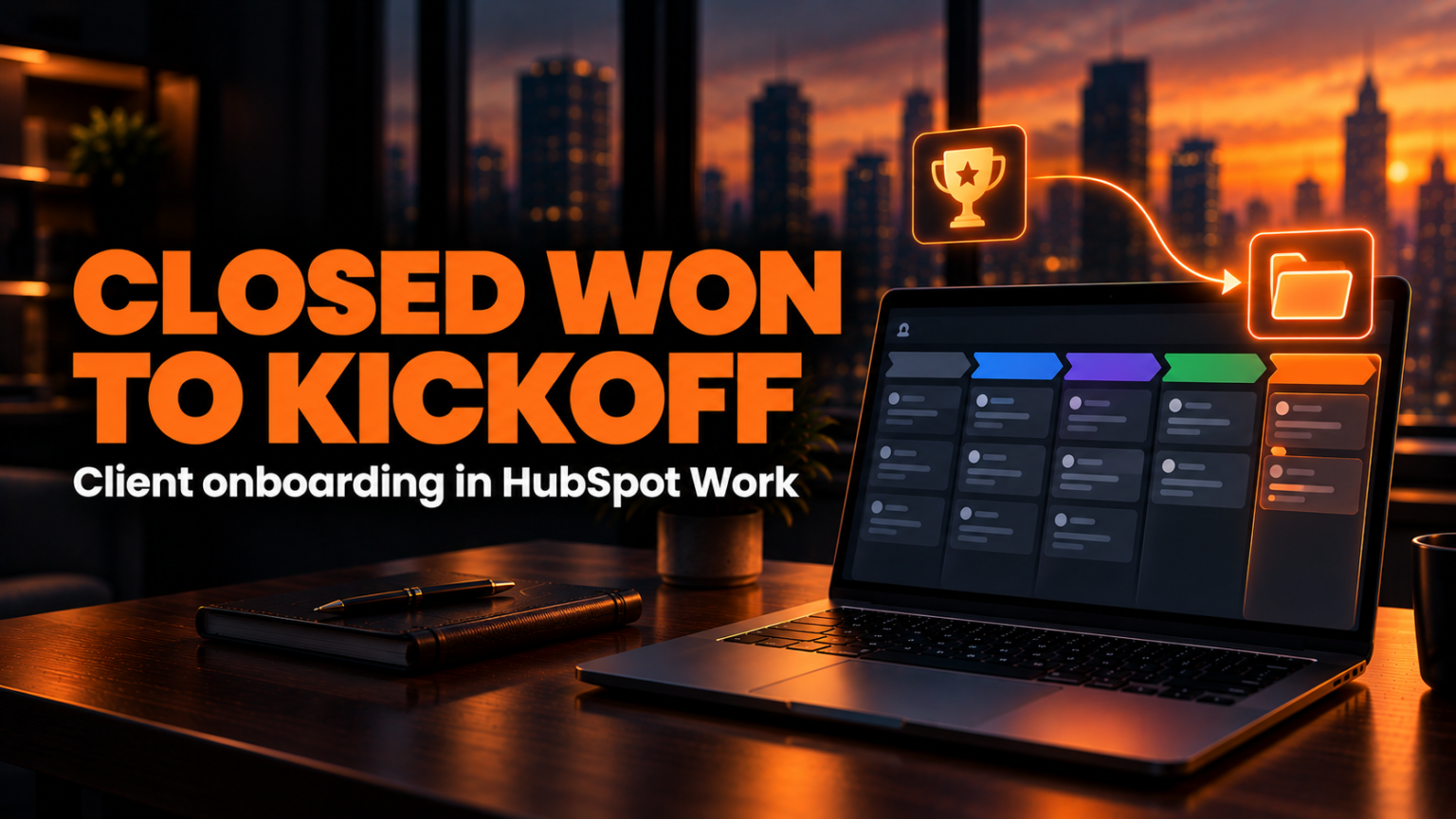
Run Client Onboarding Inside HubSpot With HubSpot Work
When a deal closes, onboarding usually moves to...

October 12, 2026
The deal closes. Sales celebrates. The contract is finally signed. Then the onboarding team gets on the kickoff call and asks the customer the exact same questions they just spent three weeks answering during the sales process.
It is a terrible look. It immediately erodes trust. The customer realizes that your internal departments do not talk to each other.
In military operations, a failed handover of intelligence creates chaos. In business, a botched handoff from sales to customer success burns your retention rate before the project even begins.
Companies try to fix this by forcing sales reps to fill out massive spreadsheets or long transition documents after a deal closes. Sales reps hate administrative work. They rush through it or skip it entirely to get back to selling.
The fix is not more paperwork. The fix is building a system that extracts the knowledge automatically. Here is how to run client onboarding directly inside your CRM using the new HubSpot Work feature.
You do not need to build this architecture from scratch.
Click Work Management in the left sidebar of your portal. Note that HubSpot Work is currently in public beta. An admin on your team may need to turn it on in your settings first.
Once you are in, click Use Cases, then select Client Onboarding. Click the button to use this template. HubSpot automatically fills in the prompt for you. Click Send.
Before the system builds the workspace, it asks which automations you want to turn on. Pick the option to enable both, then hit Submit.
The AI builds the entire project infrastructure in seconds. It creates an intake agent. It generates a task template designed to take the client from the welcome stage all the way to go-live. It builds a handoff template. Finally, it creates a master overview dashboard of every active onboarding project.
Building systems that do the administrative heavy lifting for your team is exactly The Difference Between a CRM and a Revenue Engine. The software handles the structure so your operators can focus on the client.
The value of this system triggers the moment a deal is won.
When a rep moves a deal to the closed won stage in your pipeline, the automation fires. Back in Work Management, the intake agent instantly creates a dedicated folder for the new client.
Inside that folder, it builds a specific task tracker. More importantly, it drafts a complete handoff document pulled directly from the deal’s history. The master overview immediately shows the new client sitting in the Welcome stage.
The data follows the customer. Manual data entry is a massive drain on your team. It is a perfect example of Why Execution Capacity Is What’s Killing Your Pipeline. Automating the handoff preserves that capacity. Your onboarding specialists start their day with a brief already waiting for them, completely bypassing the manual data collection phase.
Open the newly generated handoff document.
You will see that it successfully pulled the deal amount, the primary contact details, and the specific pain points and training concerns from the sales notes.
But you must check it. AI is a powerful assistant, but it is not an autopilot.
Sometimes it misreads a minor detail. It might say the deal closed on a Tuesday when the actual record says Wednesday. Fix those small errors before the kickoff call.
The AI might also flag that no company record is linked to the deal. That is a CRM data fix, not a document fix. It tells you that your sales reps are moving deals without linking the proper accounts. Catching these systemic errors is why we follow strict rules on How to Deploy Native HubSpot AI Without Breaking Your Customer Data. The AI will highlight your bad data hygiene very quickly.
Every client has a slightly different onboarding process. Instead of forcing everyone through the exact same generic task list, you can adapt the plan based on the client’s actual needs.
You can ask Breeze Assistant to review your Client Onboarding project and suggest how to modify the tasks for specific companies. Always instruct Breeze to show you the proposed changes first, without actively modifying your existing project.
Breeze will review the setup and generate a customization plan. It typically recommends keeping your standard template as the baseline, then adapting the final checklist. It usually suggests verifying five core areas: what was actually sold versus what is out of scope, which internal teams need system access, what data integrations are required, what deliverables the client needs before go-live, and exactly what Customer Success needs to take over.
The goal is to maintain a consistent baseline process while staying flexible enough to account for reality. Breeze proposes the plan, but your team reviews it before anything changes.
Automation comes with a hard cost. Each automated run uses HubSpot credits.
Running this specific client onboarding generation averages about 150 credits per use. You need to set a monthly limit in your portal settings that actually fits how many clients you expect to onboard. You do not want a sudden spike in closed deals to drain your AI limits for the entire month.
The goal of this entire setup is simple. The deal history must follow the customer. Nobody should ever have to ask the same question twice.
If nobody owns that handoff process every week, your retention will suffer. That is the exact work our operators run. Book a meeting with us.
When a deal closes, onboarding usually moves to...

An urgent ticket and a routine question look...

A closed ticket doesn't tell you whether the...

When every support email lands in one person's...

Trading emails to find a meeting time is...

Learn how to use HubSpot AI to create...