HubSpot, Revenue Operations

Bottoms Up Forecasting Is the Only Way to Know If Your Revenue Target Is Real

Published:

Share:

Your boss hands you a number. Hit $2M this quarter. Now figure it out.

That is the top-down approach. You take a target and reverse-engineer what you need. More sales reps, more budget, more pipeline. But the math is disconnected from reality because nobody checked whether the inputs actually support the output.

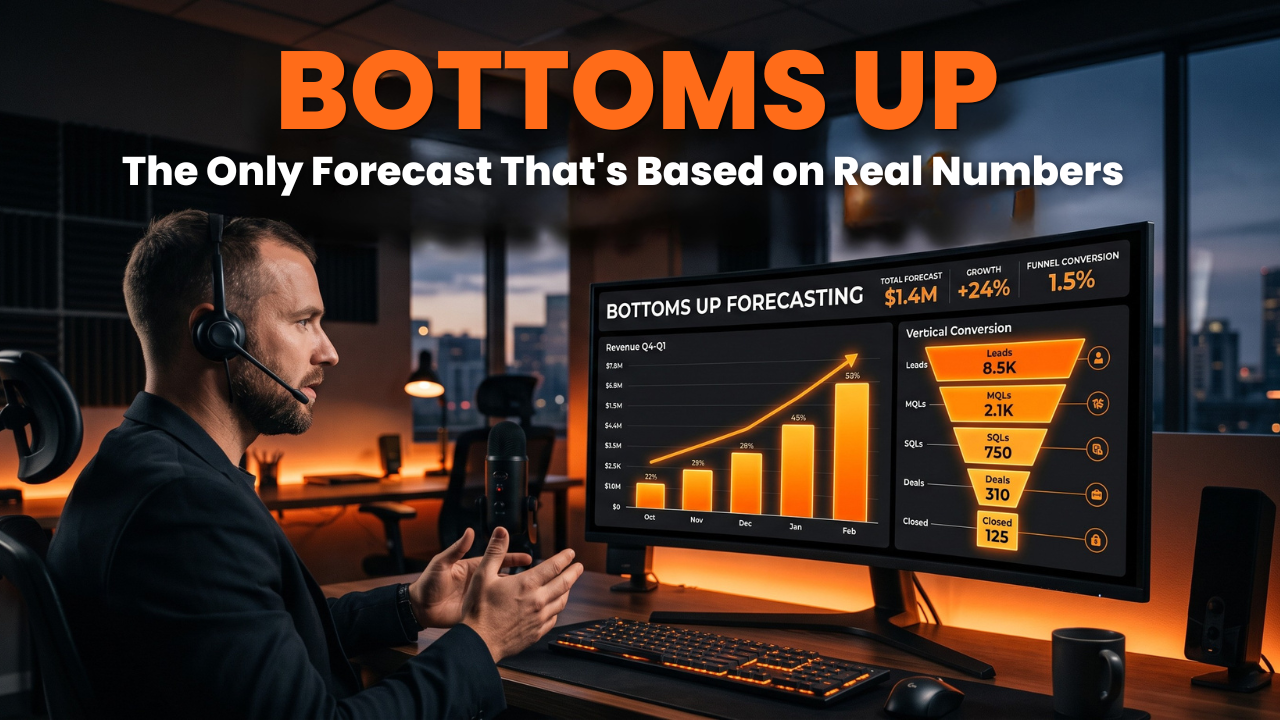
Bottoms-up forecasting flips that. You start with the data you already have in your CRM, apply your real conversion rates at every stage, and let the math tell you what is actually possible. One approach starts with a wish. The other starts with evidence.

You Need Both Approaches, Not Just One

I am not saying top-down is useless. You need a target. But you also need a reality check against that target. That is where bottoms-up comes in.

And the same goes for qualitative versus quantitative. Sitting down with your sales team, asking them which deals they think will close, getting a feel for what is renewing and what is not. That matters. But gut feelings without data behind them are just guesses. You need both.

Bottoms-up forecasting is one way of slicing the pie. You can slice it by time, by product, by ICP, by source. The point is you are building from real numbers instead of working backward from a goal.

Lifecycle Stages Are the Infrastructure

Here is where it gets practical. In order for bottoms-up forecasting to work, your lifecycle stages have to be set up correctly in HubSpot.

You need to know the dates a contact hit each stage. When did they become an MQL? When did they convert to an SQL? When did the deal close? Those timestamps give you your actual conversion rates at every stage.

Without that infrastructure, you are guessing. With it, you can run real math. If you want to understand how lifecycle stages connect to the broader revenue operations picture, What Is Revenue Operations? (And Why It’s Not Just Sales Ops) breaks down why that foundation matters.

The Conversion Rate Chain

Say you generated 100 MQLs from webinars last month. Historically, 50% of your MQLs convert to SQLs. Then 30% of those SQLs become closed-won deals. That gives you a 15% overall conversion rate from MQL to customer.

So from 100 MQLs, you expect 15 deals.

Now you do the same thing for paid ads. For partnerships. For every go-to-market motion you are running. That is why tracking the source accurately matters. If you cannot tell where a lead came from, you cannot tell which channel is actually producing revenue.

I like to base my conversion rates on the last 90 days of closed deals. It gives you a more accurate picture than averaging across your entire history. A company that has been in HubSpot for five years has different conversion dynamics now than it did in year one. The last 90 days tells you what is happening today.

Volume Is Not Optional

Here is where teams get stuck. They optimize conversion rates and ignore that the top of the funnel is empty.

You cannot be delusional about this. You cannot just optimize everything and expect to double revenue without increasing volume. Conversion rate optimization is a never-ending process, and it matters. But if you only have 50 leads coming in, converting 5% better does not move the number. You need more input to get more output.

That is the balance. Optimize your conversion rates at every stage. And increase the volume of your controllables, your go-to-market motions, at the same time. If the execution side of that equation is breaking down, Why Execution Capacity Is What’s Killing Your Pipeline explains how that shows up.

When Does the Revenue Actually Land?

This is the part people skip. Forecasting is not just how much. It is when.

Take that June cohort of 100 MQLs. You expect 15 deals to close. If your average sales cycle from MQL to close is two months, those deals land in August. Not June. Not July. August.

That monthly cohort view is what turns a forecast into something your finance team can actually use. You know the deal count, the average deal size from the last 90 days, and the timeline. Multiply it out and you know what revenue to expect and when to expect it.

And then add a 20% buffer. That is the standard margin of error I see companies use. Because there are always factors you do not have access to. The economy shifts. A champion leaves the company. A deal stalls for reasons nobody predicted. Do not hand over your forecast number without building in that cushion.

Build From the Data Up

Bottoms-up forecasting is not complicated. It is conversion rates, volume, sales cycle timing, and a buffer for reality. The hard part is having the infrastructure in place to record the data at every stage.

If your lifecycle stages are clean and your source tracking is accurate, the forecast builds itself. If they are not, that is the first thing to fix.

Want help getting your HubSpot set up to run this model? trailBlazer6.

Latest Posts